
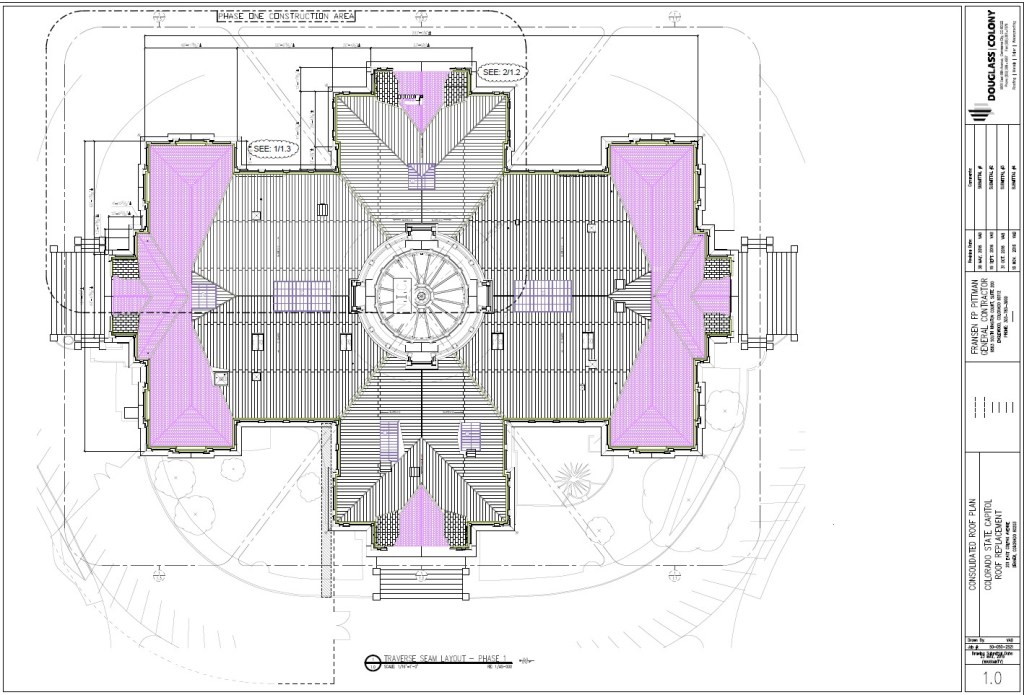
The pink rectangles symbolize a slate tile roof that is not insulated.
The black stripes represent the metal standing seam roofing panels that have approximately 1-1/2″ of polyisocyanurate spray foam.
Importance of Insulating Government and Corporate Buildings
The building with the offices of those that champion themselves as fighters for both saving taxpayers money and of climate change has very little insulation over a majority of the building and no insulation over the north and south ends. They aren’t saving taxpayers any money and they aren’t fighting climate change if they aren’t doing anything to reduce energy use in the building where the Governor, Treasurer, and all 100 Legismobsters work. This is quite a hypocrisy by all of them. It’s very compounded by repeating these failures of failing to insulate approximately 99% of all government and corporate buildings. Republicans main slogan is to say they are saving money in the government, except they refuse to do simple things such as insulate to reduce the purchase of natural gas to heat and cool the place or any place. Democrats pretend to fight climate change, but won’t do a thing to reduce greenhouse gases in their own buildings or any other buildings. Both shades of paint within the Uniparty officials are not working for you and me. They only work for those that donate enough money to them to influence their behaviors. The failure to insulate government and corporate buildings is a bipartisan act to serve certain corporations and people, not you. This failure wastes between 4.6% and 9.2% of all energy consumed, which translates to a wasting of similar amount of money as well. That’s also a lot of greenhouse gases that have no reason for being in out atmosphere.
Facts from US Department of Energy
- 40% of all energy consumed is through buildings.
- 23% of all energy consumed is used to heat and cool buildings
- 20% to 40% reduction of energy use by insulating buildings
Therefore: 20% * 23% = 4.6% and 40% * 23% = 9.2%
Not insulating government and corporate buildings wastes between 4.6% and 9.2% of energy. Insulation is a simple fix that does have a payback, but our government and the corporations that own the buildings refuse to insulate them to reduce the use of fuel, reduce taxpayer money required to buy fuel, and reduce greenhouse gases.
Examining 2015/2016 Roof Replacement of The Colorado State Capitol
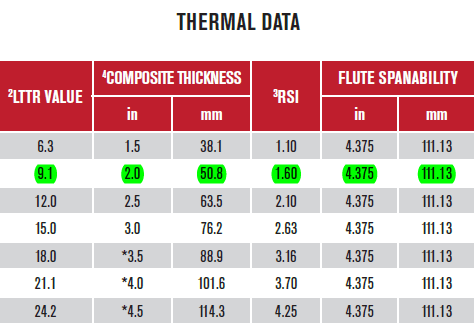
Highlighted in green is Humphries Poli’s choice of the 2.0″ thickness of metal standing seam panels that also include a sheet of plywood used as a nailer to the existing wood decking of the State Capitol.
The corresponding R value is 9.1.
There were choices of up to R 24.2.
Let’s examine the insulation placed during the Colorado State Capitol Roof Replacement project that was designed in 2015 and constructed in 2016. Most of the roof was replaced with standing seam sheet metal panels. These panels are shown in the black lines of the roof plan placed at the top of this article. The standing seam sheet metal panels were constructed at an Atlas Roofing factory and shipped to Denver. The panels were constructed like a 2″ thick sandwich with the top slice of that sandwich is the sheet metal roofing; a plywood nailer board of 5/8″ of Oriented Stand Board (OSB) is the meat of the less than tasty sandwich, and bottom slice being the approximately 1-1/2″ polyisocyanurate spay foam. Combined this sandwich creates a much less than impressive thermal resistance value or R value of R 9.1 for the entire roof assembly system shown in the table within the product information sheet. They could have done better, but chose not to.
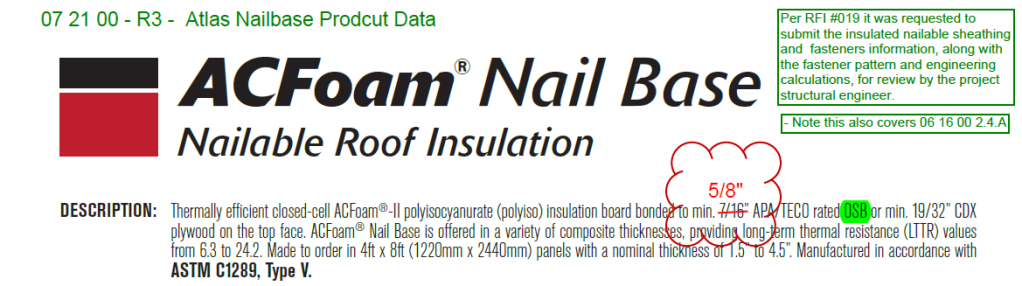
As shown by documents, the private architect of record, Humphries Poli did not design the roof to have any insulation. Records requests for drawings did not show any work created by Humphries Poli. From requested records for drawings of the latest roof or ceiling replacement, the State Architect sent shop drawings created by roofing contractor, Douglas Colony. Humphries Poli did review and approve those drawings after the 3rd submission, but that’s it. Douglas Colony designed and constructed their own details for the roof. This is further proof that an architects license does not protect the public, particularly when a contractor who is not a licensed architect designed the entire roof.
All of the entire 1-1/2″ of insulation was only due to the roofing contractor that requested it with a formal Request For Information (RFI). The reason why that contractor sent the RFI was because the manufacturer of the metal panels only sold panels that came with some insulation. Building codes were demanding that government and corporate buildings be insulated for the first time. Quite naturally, the manufacturer needed to add insulation to those panels to sell their product to meet changing building codes. The manufacturer conformed to changes in the code, but the government that enforces code refused to do that.
Both Government & Private Licensed Architects Had Choices, But Ignored Them
The private architecture firm, Humphries Poli was given the choices of depths of insulation, they chose the 2nd least amount of insulation available from the manufacturer. This was authorized under the supervision of State Architect and former State Representative from Evergreen (R), Cheri Gerou, AIA. The design for the roof was completed in 2015 after the changes to the 2015 International Building Code (IBC) were written and published, but not adopted by the Colorado General Assembly. Those changes were the first mandate to insulate government and corporate buildings with a low bar of R 15 in the Front Range cities including Denver. Yet, the State refused to even try to hit that low bar to reduce government cost, conserve energy, reduce natural gas use, or reduce its output of greenhouse gases known to cause global warming and climate change. The replacement metal panels were installed the next year in disregard of protecting the public or saving money on natural gas or electricity for the pumps and other heating and cooling equipment in the building. The ROI on insulating buildings is approximately 5 years. Purchasing and installing thicker roof panels certainly would have paid itself off by now and reduced the amount of money spent on natural gas to heat and cool the giant granite box and the State’s carbon footprint.
As shown in the table above, both the State Architect, Cheri Gerou, AIA and Humphries Poli had many options to have met that 2015 IBC for new construction or exceed it. Most likely, the manufacturer of the metal panels for the roof assembly created the multiple thicknesses of panels to meet the 2015 IBC requirements and sell them across the country. Instead of choosing to follow or even improve upon the 2015 (IBC), the roof was designed to meet the 2012 International Building Code (IBC), which did not demand any insulation in any government or corporate owned buildings. The 2015 version of the IBC was the very first code to mandate that new construction of government and corporate owned buildings were insulated.
Comparison of 2012 IBC/IRC & 2015 IBC/IRC Building Codes:
Thermal Resistance Values of some building sample types in Front Range Cities according to 2012 IBC/IRC building codes:
- Houses: . . . . . . . . . . . . . . . . . . . . . . . . . . . . . . . . R – 30
- New Construction of Apartment Buildings: . . . . R – 0
- Existing Apartment Buildings: . . . . . . . . . . . . . . R – 0
- New Construction of Corporate Buildings: . . . . R – 0
- Existing Corporate Buildings: . . . . . . . . . . . . . . . R – 0
- New Construction of Government Buildings: . . . R – 0
- Existing Government Buildings: . . . . . . . . . . . . . . R – 0
The IBC/IRC codes are published every 3 years. Here is the next generation to compare above of Thermal Resistance Values of some building sample types in Front Range Cities according to 2015 IBC/IRC building codes:
- Houses: . . . . . . . . . . . . . . . . . . . . . . . . . . . . . . . . R – 38
- New Construction of Apartment Buildings: . . . . R – 15
- Existing Apartment Buildings: . . . . . . . . . . . . . . R – 0
- New Construction of Corporate Buildings: . . . . . R – 15
- Existing Corporate Buildings: . . . . . . . . . . . . . . . . R – 0
- New Construction of Government Buildings: . . . . R – 15
- Existing Government Buildings: . . . . . . . . . . . . . . R – 0
When asked for any discussions why the no mandated insulation of the 2012 IBC was used in lieu of a better performance for the People that own the State Capitol, this was the answer I received from Jolina Lewis, Open Records Request Liaison of the Department of Personnel & Administration on behalf of the State Architect Tana Lane: “At the time when this project was designed, the State of Colorado had adopted IBC 2012. Typically after a new code is released, it takes a year to formally adopt that code. If you have any questions on the current codes adopted by the State of Colorado, please visit https://osa.colorado.gov/state-buildings/building-codes.” I was expecting an answer that bad. Another possibility of bad excuses I expected was that we still don’t have codes applying to existing government and corporate buildings for insulation. The reality is that they could have and knowingly should have done better. Codes are the floor of building quality. They had the option to do better, much better. They obviously did this project in 2015 to not conform to more stringent codes and buy as much natural gas from Xcel as oil and gas then-Governor John Hickenlooper could sell. Hickenlooper always ensured that the corporations would get their money’s worth from the State. He acted as his briber’s salesperson as Mayor of Denver prior and is still performing that corrupt role to this day in the US Senate.
Short History of Excuses Used Nationwide
The 2006 IBC was the first building code to mention the word insulation for government and corporate owned buildings. Ironically, houses across the US have been mandated to be insulated by the since the late 1970s, but the big heating and cooling hogs across the country such as big box stores, stadiums, gymnasiums, city halls, and state capitols are not insulated to conserve energy, reduce costs, limit natural gas use and fracking, or reduce greenhouse gases. We conserved energy in the little boxes, but maliciously failed to do so in the big energy users. There is no logic to create that reality. This is done for the sole purpose of filling up the bank accounts of the very wealthy’s. A professor of mine for my Building Construction Management degree who doubled as a developer said developers and building managers will NOT invest in a property unless they get a Return of Investment of less than 3 years. The ROI of insulating buildings is generally 5 years. I remember doing those calculations years ago. What the wealthy will not do, their government will gleefully take your money to spend it on the wealthy via utility companies like Xcel who has a monopoly over Denver where the Colorado State Capitol is located. A monopoly with a guaranteed 10% profit margin and $8 million for its CEO. The only think that could drive that is bribes to maximize natural gas use sales. Yes, the bribes by Xcel and other utility corporations are abundant in the Legismobster and other parts of the state government to put on a fake regulatory scam that benefits the utility. It also expands fracking for natural gas. The failure to insulate the State Capitol serves corporate profits at the expense of the People.
Public Safety Of Licensed Architects?
There will be in-depth stories on the lack of public safety and reasoning to have a license for architects, but it must be mentioned that both the licensed architects of the private firm and State Architect did nothing for public safety in this situation. A few facts of the architects licenses at DORA:
- 0 Colorado resident licensed architects have had their licensed suspended or revoked since May of 1995.
- $500 is maximum fine.
- 0.53% chance of obtaining a license after earning the accredited degree and applying for the license.
- 9 Black licensed architects out of ~7,800 licenses. 1 of those 9 is a woman.
The license gives the public no public safety, no regulation, but gatekeeps to protect a club that bribes our politicians for that protection from competition.
The American Institute of Architects (AIA) is the corporation with its subsidiaries administers all architects licenses. They simply tell the government who they will allow to have a license. The government is the enforcer for the corporation. Magically, the AIA is the corporation that writes the insulation portion of the building codes. They submit their writings to the International Code Council that organizes the many corporations that write building codes and publishes them as the IBC, IRC, and a few other code books with the word International in front of it.
Lack of Equal Treatment Between Houses and Government & Corporate Buildings
Do laws apply to our government? They certainly do not think so. There are plenty of questions whether there are equal treatment of the law. Here are a few examples:
- Houses vs. Government/Corporate Buildings
- Apartment Tenants vs. House owners
- Existing Buildings vs. New Construction
All make one scratch their head as why one, but not the other. Yes, the answer is money, power, and access.
Houses must be insulated, but the State Capitol, grocery stores, school gymnasiums, and apartment buildings are not. Why are apartment buildings not mandated to be insulated, but houses are? Apartment buildings are owned by landlords that bribe politicians either directly or through their Apartment Association. So they don’t have to insulate their apartment buildings. By failing to insulate, landlords force higher utility bills to heat and cool apartments on to the tenants. Same rationale is used for the State Capitol aka the People’s House. We are treated as though we are tenants in a house we own and the landlord (the government) just siphons money from us to give it to their friends. It’s not just the financial cost, but also a climate cost.
The resulting public psychology of mandating insulation of houses has effectively made people turn the other way to the fact that their much larger heating and cooling hogs of government and corporate buildings remain not insulated. Much of the public thinks that because their personal house is insulated that their State Capitol, grocery store, or local school is as well, but they aren’t. Model building codes still don’t touch on insulating existing government and corporate buildings.
Short History of Insulation in Building Codes
The mandating of insulation of houses through residential building codes was started during the President Jimmy Carter administration in the late 1970s. The stated purpose was to save energy after the energy crisis of 1973, which was about crude oil while most heating systems use natural gas, primarily methane. The insulation of houses has effectively made people turn the other way to the fact that their government and corporate buildings they use remain not insulated. The current International Residential Code (IRC) mandates newly constructed single family houses in Denver and the rest of the cities of the Front Range to having a heat resistance value or R value of R-60, which is about 28″ of that fluffy pink stuff or 10″ of the spray foam, polyisocyanurate. Housing building codes in the US have increased from R-0 to R-60 in just over 40 years.
The current International Residential Code (IRC) mandates newly constructed single family houses in Denver and the rest of the cities of the Front Range to having a heat resistance value or R value of R-60, which is about 28″ of that fluffy pink stuff or 10″ of the spray foam, polyisocyanurate. Housing building codes in the US have increased from R-0 to R-60 in just over 40 years.
R Thermal Resistance Values of some building sample types in Front Range Cities according to 2021 IBC/IRC Building Codes:
- Houses: . . . . . . . . . . . . . . . . . . . . . . . . . . . . . . . . R – 60
- New Construction of Apartment Buildings: . . . . R – 30
- Existing Apartment Buildings: . . . . . . . . . . . . . . . R – 0
- New Construction of Corporate Buildings: . . . . . R – 30
- Existing Corporate Buildings: . . . . . . . . . . . . . . . R – 0
- New Construction of Government Buildings: . . . R – 30
- Existing Government Buildings: . . . . . . . . . . . . . . R – 0
The government and corporation buildings with much bigger boxes requiring much more natural gas to heat and cool are a completely different story. The first mention of the word insulation for government and corporate buildings in a building code did not appear until 2006. The first mandatory insulation for new construction for the much bigger boxes of government and corporate buildings didn’t happen until the 2015 International Building Code, which guides those big boxes. That’s nearly a 40 year gap between the start of insulating houses in the late 1970s until finally starting to insulate government and corporate in the late 2010s while still ignoring existing government and corporate buildings. The same people mandated your personal house be insulated, but the People’s house does not. Make sense? I hope not.
Hypocrisy and Political Theater of Anti-fracking Bills To Divide & Conquer
A couple current Democrats, Sonya Jaquez-Lewis and Kevin Priola in the Colorado Senate put together a bill to stop issuing oil and gas permits by 2030 to pacify a few “environmental groups.” Environmental groups is in quotes because they are all completely Democrat Party captured organizations that accomplish nothing, but keep their members interested and corralled in the Democrat Party. Each of these organizations has been told of the lack of insulation in government and corporate buildings. Reactions have either been silence and ignoring or screaming back, “BAN FRACKING!”. None of them will act to reduce fracking by conserving energy, which may ban fracking economically. Reasons why these reactions are given vary from extra perks to the group leaders to the mental inabilities to see reality. Those groups include 350 Colorado, Colorado Rising, Sierra Club, Black Parents United Foundation, Green Latinos, Colorado Coalition for a Livable Climate, and Wild Earth Guardians. You can see comments of what each said about the bill to get people interested in the bill in this link published on February 15, 2024 on the Wild Earth Guardians website, https://wildearthguardians.org/press-releases/colorado-legislators-introduce-bill-to-phase-out-new-oil-and-gas-permits-and-require-operators-to-fund-cleanup/ They all chose not to do anything practical such as insulating buildings. Maybe if these were the teenage Wild Earth Guardians that brought a lawsuit against Barack Obama and the US government that is still going on 9 years later, they would have sued the Governor and the General Assembly for failure to mitigate climate change and for maliciously wasting taxpayer money, but this is the Democrat’s Wild Earth Guardians now.
Instead they chose to write a bill to nowhere that demanded the Colorado Energy & Carbon Management Commission to adopt rules banning new permits for oil and gas development by 2030. Last week, they presented Senate Bill 24-159 to the Senate Agriculture & Natural Resources Committee with a inside laughter, a wink and a snort at the public their despise. There can’t be a single soul on this planet that thinks former Republican Kevin Priola believed in this bill. Ironically, he was a Republican in the House of representatives when the roof replacement project was designed and constructed. He has been under the roof of the uninsulated State Capitol since 2009. His wife Michelle Priola was one of the Plaintiffs that brought the lawsuit to remove Donald Trump from the ballot in Colorado that was overturned by the U.S. Supreme Court 9-0. If Senator Priola actually had any desire to limit natural gas extraction, he would have at the very least demanded that the very building he works in be insulated to reduce natural gas use and extraction.
Senator Sonya Jaquez-Lewis began the testimony for the bill in a building that is NOT insulated with bothsidesing: “Senate Bill 159 is a much needed, huge coalition driven policy that demonstrates our commitment to our state’s climate goals and the need for policy change to realistically address climate change. The oil and gas industry is important to Colorado, but in order to meet our clean energy goals we cannot keep drilling forever. This industry is the number one source of our severe air quality problem and it is negatively impacting public health.” https://sg001-harmony.sliq.net/00327/Harmony/en/PowerBrowser/PowerBrowserV2/20240328/-1/15667#info_
Her bothsidesing the bill from the start should have been a sign that she was not sincere to the “huge coalition” of Democrat Party captured environmental groups she was pandering to. Giving that bothsidesing in a building that is NOT insulated only means that she is trying to lead those environmental groups off a cliff to intentionally never allow them to win.
The bill’s testimony didn’t start until 2:41 pm. It was the only bill of that committee for the day. That late of a start for a Committee is unusual, but is typical of the dog and pony bills that the General Assembly does not take seriously. 8 hours and 58 minutes later, the Senate Agriculture & Natural Resources Committee voted 5-2 to “Postpone Senate Bill 24-159 indefinitely using a reversal of the previous roll call. There was no objection to the use of the reverse roll call, therefore, the bill was postponed indefinitely.” https://leg.colorado.gov/bills/sb24-159 All of the Committee voted to stop the hearing. After a recess, the two sponsors voted to use the reverse roll call, but put on their show to vote for the continuation of the bill. None of them were ever serious in the first place. They wanted to go home. They gave enough of their dog and pony show to keep those environmental groups captured by the Democrats interested in being pawns.
For this political theater, the “environmental groups” were able to say an ‘Aw shucks we tried. We’ll have to bring this bill about nothing back to the people of nothing next year’ type statement. Democrats received a tighter stranglehold over their “environmental groups” by faking like they did something. Republicans and their public relation groups such as the dependent Independence Institute, Common Sense Institute, and the American Petroleum Institute told their minions that they fought back against the Democrats and beat them. They didn’t. But it intended to serve to keep a tighter stranglehold on their voters, just like the Democrats did. In the end, it created a further division between those that still follow these parties. It’s a game to divide and conquer. Some are too self-absorbed into their echo chambers to see the political theater and hypocrisy that spin them.
Colorado Concern is a political action group comprised of most of the wealthiest people in Colorado and solely acts to protect their wealth. It OWNS both the red and blue servants. Here’s one of their tweets on this issue to laugh at:
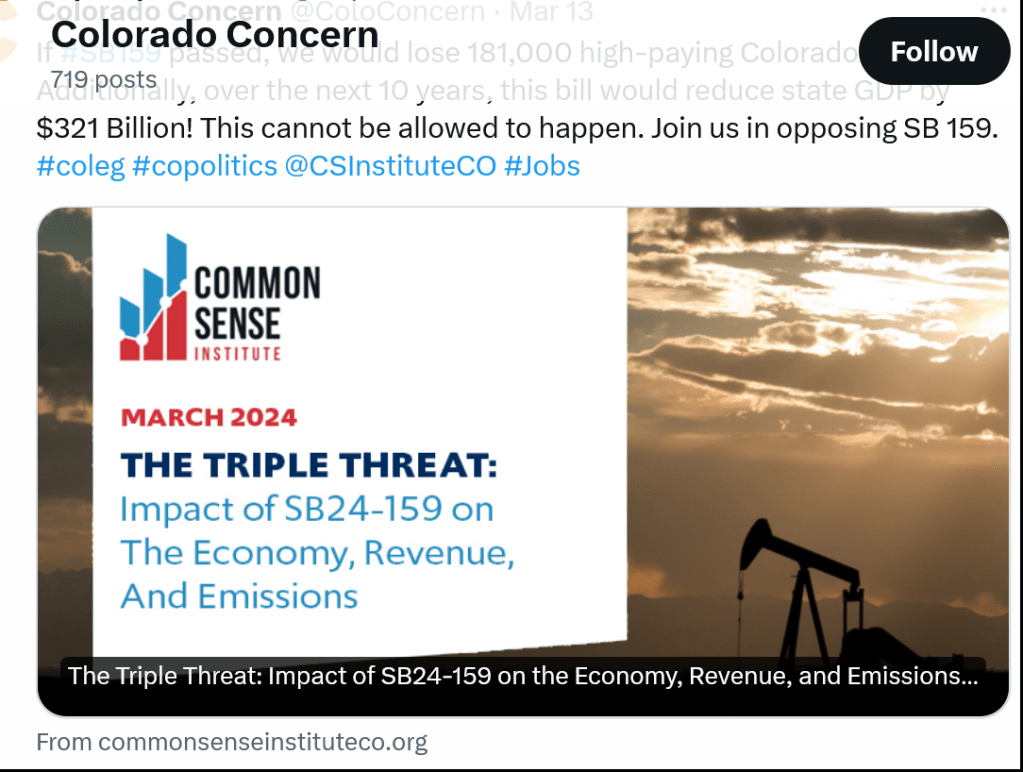
Colorado Concern is a political action group comprised of most of the wealthiest people in Colorado and solely acts to protect their wealth. They don’t give a damn about number of jobs, a jobs number that is terribly inflated to create fear. A scroll through Colorado Concern’s X page reveals features of many Democrats. When Colorado Concern makes a public statement on a bill, that bill is either political theater or for them. No one in the General Assembly is going to cross that organization, NO ONE! Colorado Concern always gets its way in the Colorado General Assembly.
This is just one story in a series of stories on the failures to insulate government and corporate buildings while demanding houses be insulated. There were be stories on other government and corporation buildings that are not insulated. There will be in depth stories on why they are not insulated. Not insulating government and corporate buildings does not serve anyone in the public. The bottom line is that neither major political party will act until Wall Street tells them they can make money off climate change. Making money for the bribers of the aristocracy is the ONLY thing that ALL 100 in the General Assembly care about.
Feel free to review any of the public records obtained for this article at the following link: https://drive.google.com/drive/folders/1X6oFbPCoP58lL_jZ-5xkcoSaJi6oeiP_?usp=drive_link
By Frank Sturgell
CashApp: $FrankSturgell

 Colorado People's News
Leave a reply to OP-ED FROM FELLOW COUNCILOR Part 2: PLEASE DO NOT VOTE FOR REBEKAH STEWART FOR COLORADO STATE HOUSE DISTRICT 30 – Colorado People's News Cancel reply